Friday, May 31, 2013

Birds' Singing is an Audible Profile


     Researchers at Duke University found that a male bird's singing may show his strengths and weaknesses to potential mates. For a long time it was believed that the more songs a bird knew, the smarter it was. This experiment found that while birds with large singing repertoires excel in some areas of cognitive function, their singing ability also leaves them with deficiency in other areas. This is because while the bird is developing resources may either mostly go to the HVC, the song controlling area of the bird's brain, or the hippocampus, the part of the brain that controls spatial learning. This is important because birdsong is a good way of studying speech development.

NOS Themes:
  • Science is collaborative
  • Science is based on evidence
  • Role of chance
http://www.sciencedaily.com/releases/2013/05/130521194141.htm

Benefits of Learning Biology

Conducting an experiment involving 1,516 students at Kansas State University, researchers found that students who did well in biology were able to perform exceptionally well in rigorous genetics course. This was expected, but what researchers found was that even after several years, students didn't forget what they had learned in biology and were able to apply it to a hard genetics course after several years.
NOS:
Science is based on evidence
Importance of Repetability
http://www.sciencedaily.com/releases/2013/05/130531132737.htm

Mountain Populations Offer Clues to Human Evolution

In recent studies, scientists have been researching the differences of human evolution up in mountainous regions. This, according to professor of human genetics Anna di Rienzo, is a whole different case of natural selection. These observations can supposedly be important towards the field of evolutionary biology by examining the different DNAs of people living in the mountains. 

As people transition to higher elevations, there starts to become a problem with getting enough oxygen. However, the human body does its part to attempt to adjust. According to this article, some produce higher levels of hemoglobin, which allows for greater circulation of oxygen. However, because higher levels lead to blood clot, studies have shown that living in the mountains are a lot easier for those whose ancestors have been occupying those regions for generations. 

 Studies on people of Tibet by Dr. Nielsen have shown that these adaptations in DNA have found that the gene EPAS1 was the main factor in adapting to different altitudes. However, studies in Nigeria by two other teams examined the genes of Ethiopians also living in high altitudes, and found no EPAS1 present. Instead, the gene BHLHE41 was prominenti n their DNA. It was concluded that both genes allow for humans to better cope with varying levels of altitudes. However, more work will have to be done to figure out the differences of the workings of those two genes.

 NOS Themes:


 Science is collaborative; multiple teams of scientists worked in attempt to figure out the adaptations in people's DNA


 Science is subject to debate and tentative; the two teams of scientists had conflicted findings with two different genes. It is subject to debate as to what each one will exactly do. 


Role of motivation and curiosity; scientists were interested and curious as to how different humans around the world adapt to different levels of altitude. 


http://www.nytimes.com/2013/05/30/science/mountain-populations-offer-clues-to-human-evolution.html?_r=0&adxnnl=1&adxnnlx=1370061677-WTpjaVCLsC1k9U3ayloPHA


Adrianna Tan Hour 3

Apes Get Emotional Over Games of Chance

          
              Researchers say that, like humans, chimpanzees and bonobos throw angry tantrums and pout whenever a risk-taking strategy doesn't go their way. It is known that emotions play a critical role to humans in making complex decisions, but researchers wanted to know if the processes are shared with other animals when making decisions.The experiment started with the apes having to make a choice on whether they wanted to obtain a large reward or take a chance to get a high-quality treat. If they take the chance for the high-quality treat, they risk receiving a non-preferred food item if their gamble does not go how they want it to. When making these decisions, chimpanzees were more patient and likely to take risks than bonobos. Anger, pouting, scratching, and tantrums were all responses when their choice showed the less preferred outcome. A few of the responses that were displayed were species-specific but others were unique differences to the animal. Overall, the researchers stated that the apes did show emotional responses to decision making.
Themes of Nature of Science:
Science is based on evidence: The researchers had to perform the tests to get their evidence that apes did show the emotional responses.
Role of motivation and curiosity: If someone wasn't curious about the apes, we would never know that they had emotional responses to decision making.
Importance of repeatability: The tests about the apes were probably done many times to make sure that that their responses were not a one-time thing.
Link to article: http://www.sciencedaily.com/releases/2013/05/130529190933.htm

Rats Eyes Move in Opposite Directions?

http://www.biologynews.net/archives/2013/05/28/rats_have_a_double_view_of_the_world.html


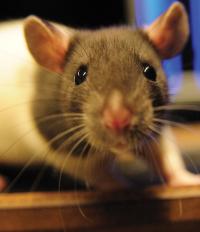
Scientists have recently discovered that Rats move their eyes in opposite direction when running around. Using small high-speed cameras, they have discovered the motions of the rat's eyes. Their eyes allow them to be constantly surveying the area above them, watching for predators. This observation also shows that rats do not fuse the visual information into one image, like humans. Scientists hypothesize that this vision drastically helps them survive against birds and other predators.

NOS Themes
Role of motivation and curiosity
Science is based on evidence

Robo Bee

ROBO BEE
This Robotic Bee Just Took Flight, to Pollinate Crops and (Maybe) Spy on You
Lukas Wood
http://www.scientificamerican.com/article.cfm?id=this-robotic-bee-just-took-flight-t-2013-05

 After 12 years of work, researchers at the Harvard School
 of Engineering and Applied Sciences have succeeded in creating a fly-like robot. It is about the size of a quarter and weighs 80 milligrams. its wings are designed just like an insects.  At the moment there isnt a small enough battery to support the robobee for more than 20 seconds. One of the first goals for the robobee was to be able to take of the responsibility of the dwindling population of honey bees in pollinating crops and flowers. another thought is that they could be used for spying.

Themes.
Science is collaborative.
Role of motivation and curiosity.

New Method Discovered for Identifying Salmonella

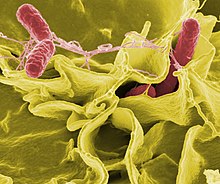
An image of salmonella,
courtesy of the Wikimedia Foundation.

                Recently, a new method of salmonella identification has been discovered which will reduce the process’s length by more than half. The standard practice, gel electrophoresis, takes several days. The new technique devised by researchers at Penn state will reduce the time to just one. This method focuses on just two genes and two other small areas of the genome, which allow for accuracy similar to that of standard electrophoresis. Considering that salmonella outbreaks need to be traced to their source as fast as possible, this breakthrough is potentially revolutionary, in terms of finding salmonella outbreaks. While salmonella only seems to kill a few hundred people a year at most, this is only because we’ve become very adept at finding and squashing the bad strains. As we become even more effective, it will only become easier to destroy them. It’s not the most extreme discovery, but it’s still a worthwhile one.

NOS Themes: 
3.) The researchers only decided that the method worked after testing it in a blind study. It will very likely have to be tested much more thoroughly before being adopted by any other institutions.
4.) This method was devised in Penn State, a relatively well-known college, by an associate professor. While this doesn't bar the individual from needing to have their work reviewed, this person is probably not making things up, as he's managed to hold his position at the university for quite awhile.