Article: http://news.nationalgeographic.com/news/2013/05/130530-mars-space-astronaut-radiation-science/
Summary: Recent results from radiation assessments on Mars show that keeping astronauts safe from hazardous radiation if and when they travel to and from Mars will not be easy. Readings from the Radiation Assessment Detector on the Curiosity rover show that astronauts would receive significant doses of high-energy galactic cosmic rays on Mars. Scientists say that the results are not surprising, but it is the first time that there is real data that shows just how much radiation travelers would get from the flight there alone. The amount of radiation received would be comparable to getting a whole-body CT scan once every five or six days for the entire trip. However, even with the threat of these galactic cosmic rays, NASA officials said that it did not make the goal of sending astronauts to Mars by the mid-2030s impossible. The best way to reduce the risk of cosmic radiation would be to lower the time it takes to get to Mars. NASA has been experimenting with ways to make the spaceships go faster. Hopefully people will be able to create a solution to the radiation so that people can go to Mars soon!
Themes of Science:
1. Science is based on evidence - Researchers used evidence from the RAD aboard the Curiosity rover.
2. Science is collaborative - Both researchers and NASA and independent researchers such as Dennis Tito are looking for ways to solve this problem with radiation.
3. Role of motivation and curiosity - People are motivated by the prospect of going to Mars.
4. Role of credibility - The rover is credible because it actually went to Mars and measured the Radiation and the new views on whether or not we will be able to make it to Mars by the mid-2030s are more credible because there is now data from the RAD.
Katherine Gao Hour 1 Gabel
Showing posts with label Katherine Gao. Show all posts
Thursday, May 30, 2013
Thursday, May 9, 2013
Brains are Tasty?
Article: http://www.sciencenews.org/view/generic/id/350107/description/Human_ancestors_had_taste_for_meat_brains
Summary: Researchers have found animal bones in Kenya which provide evidence that human ancestors living in East Africa 2 million years ago may have eaten brains of small animals. Joseph Ferraro, an anthropologist, says that eating brains could have provided the energy needed to support larger bodies. Brains helped add a side of fatty, nutrient-rich tissue to a meal. Researchers believe the gazelles they found were killed by humans because there were no other animal bites or marks.
Themes from Nature of Science:
Science is based on evidence because this is based on fossils that they found.
Role of chance - The researchers may not have been looking specifically for these types of fossils.
Role of motivation and curiosity - This topic is interesting and might lead scientists to become more curious and try to find more fossils.
Katherine Gao Hour 1 Gabel
Wednesday, April 24, 2013
Cancer's Weakness
Article: http://www.sciencedaily.com/releases/2013/04/130424102940.htm
Summary:
Scientists from the Manchester Collaborative Center for Inflammation Research found out why the drug rituximab is so effective at killing cancerous B cells. The researchers used high powered microscopes to record the process of rituximab binding to a diseased cell. They found that rituximab usually formed a cap by drawing a number of proteins to one side of the cell. When a natural killer cell latched onto a cell that had a cap formed from rituximab, it had an 80% success rate on killing the cell. When there was no cap, the diseased cell was only killed 40% of the time. Professor Daniel Davis will continue to use the same technology to investigate more about immunology at the Manchester Collaborative Center for Inflammation Research.
Themes of Science:
Science is collaborative - The research was carried out in collaboration with MedImmune, a research and development arm of AstraZeneca.
Science is based on evidence - The researchers used evidence from high powered video recordings.
Importance of repeatability - Professor Davis is going to continue to use the same technology to study immunology more in depth.
Katherine Gao Hour 1 Gabel
Tuesday, March 19, 2013
Katrina Sized Hurricanes Will Happen Every Other Year
Article: http://www.truthdig.com/report/item/katrina_could_soon_happen_every_other_year_20130319/
Summary: In the Proceedings of the National Academy of Sciences, researchers report that the amount of Katrina magnitude hurricanes could soon double because of climate change. Dr Aslak Grinsted says that their analysis indicates that we have passed a global warming threshold. While the relationship between hurricanes and temperatures is disagreed upon by scientists, these scientists combined historic data with projections of climate change, to predict how many Katrina-like storm surges would occur in the future which made their findings more accurate. The results showed that Katrina magnitude hurricanes will become ten times more likely if average global temperatures increase by 2°C. That would mean one Katrina every other year. However, Judith Curry says that the researchers used tide gauge measurements from only six US sites and that their study was based on a data set that incompletely represents US landfalling hurricane activity since 1923.
NOS Themes:
Collaboration is in this article because the study involved scientists from Liverpool, Beijing Normal University, the University of Copenhagen, the University of Lapland and Uppsala University, Sweden.
There is debate and tentativeness in this article because there are people who do not trust the study and feel like not enough data was used.
Conflicts within the scientific community is in this article because there is controversy among scientists about the relationship between hurricanes and temperature.
There is the importance of repeatability because the results of this study need to be able to be repeated to be trusted.
Katherine Gao, Hour 1, Gabel
Tuesday, March 5, 2013
Sharks for Lunch
Article: http://www.foxnews.com/science/2013/03/05/monster-find-has-erie-geologist-fishing-for-more/
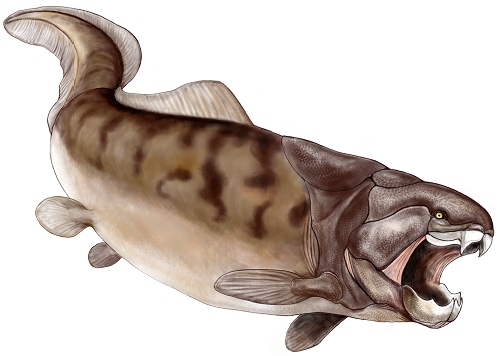
Summary: Geologist Scott McKenzie is putting together pieces of the prehistoric fish Dunkleosteus whose remains were found in Erie County, which was under a saltwater ocean 364 million years ago. McKenzie says that when the Dunkleosteus is complete, the size of the head will be similar to that of a Volskwagen Beetle. Unfortunately most of the remains are still buried under sandy shale in Erie County. The Dunkleosteus was one of the most terrifying creatures during the Devonian period because of how fast its jaws could open, creating a suction force that pulled prey into its mouth. The Dunkleostus could snap a prehistoric shark right in half! McKenzie said that the remains would be hard to locate because they are located along a stream in a heavily wooded area.
NOS themes:
Collaboration is part of this article because Scott McKenzie has to collaborate with other geologists to uncover the remains.
Evidence is part
of this article because geologists use the fossils to identify facts about the Dunkleosteus and other animals during the time period.
Conflicts within the scientific community is in this article because McKenzie is not allowed to share the site of the remains with other people because the people who own the land don't want him to.
Katherine Gao Hour 1
Subscribe to:
Posts (Atom)